Why Your Digital Marketing Campaigns Are Getting Clicks but No Conversions
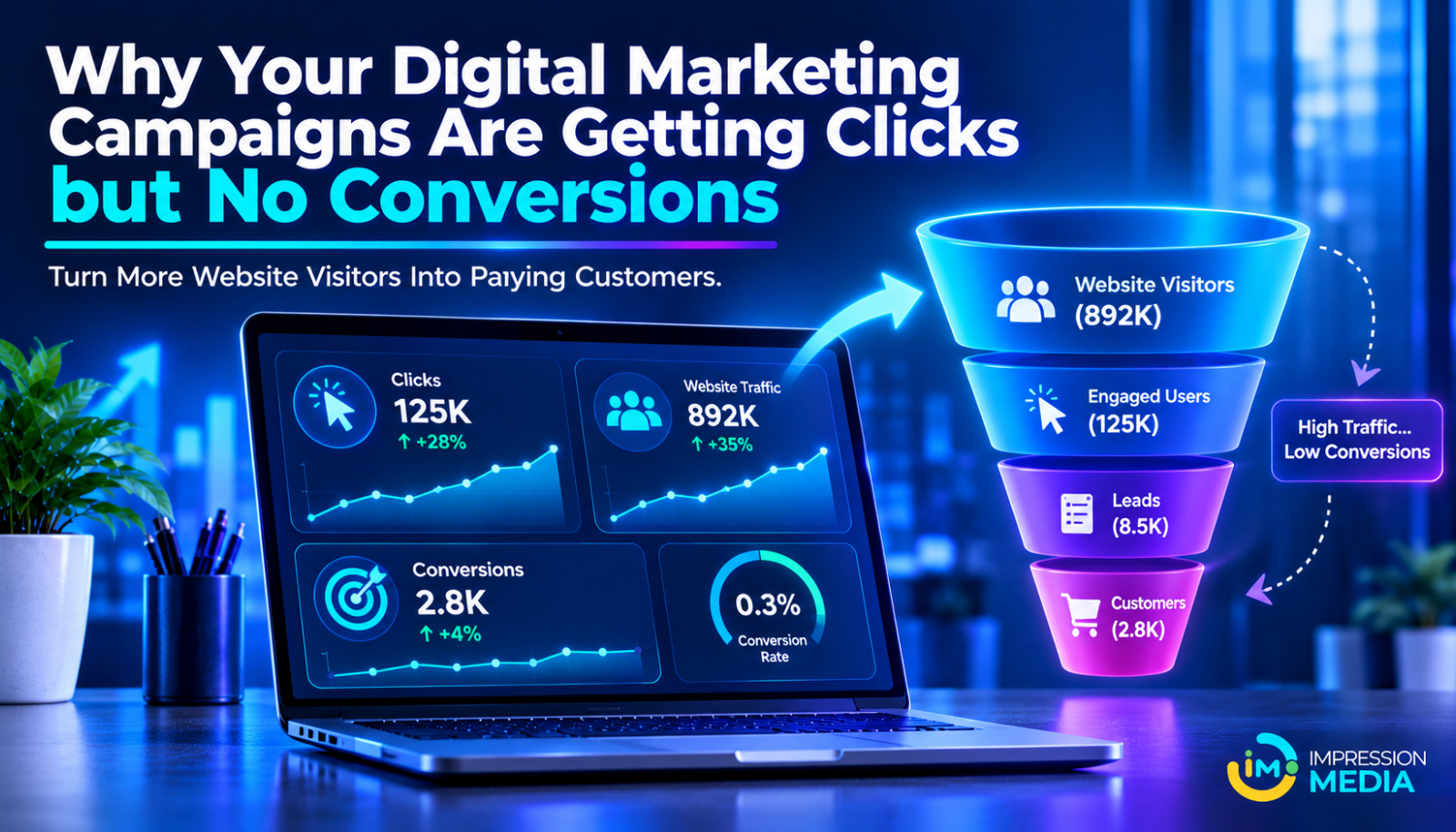
Getting clicks on your digital marketing campaigns can feel like progress. Your advertisements are reaching people, users are visiting your website, and your campaign is generating traffic. But what happens when those visitors leave without making an enquiry, booking a service, or completing a purchase?
This is a common challenge for businesses investing in Google Ads, social media advertising, and other digital marketing channels. High click numbers do not necessarily translate into business growth. If visitors are not taking the desired action, something in the customer journey may need attention.
The problem could be your targeting, advertisement, landing page, website experience, or offer. Understanding where potential customers lose interest is the first step towards improving campaign performance.
Here are some common reasons why digital marketing campaigns generate clicks but fail to convert.
1. Your Ads Are Reaching the Wrong Audience
One of the biggest reasons behind low conversion rates is poor audience targeting. Your advertisements may attract clicks from people who have little interest in your products or services.
For example, a company offering premium website development services may receive clicks from users looking for free website builders. Although the advertisement generates traffic, those visitors are unlikely to become customers.
Refine Your Audience Targeting
Businesses should review their targeting settings and focus on people who are more likely to need their offerings.
Consider:
- Customer location and service areas.
- Age groups and relevant audience characteristics.
- Interests and purchasing behaviour.
- Search intent and keyword relevance.
- Previous website visitors and potential customers.
For search campaigns, review search terms regularly to identify irrelevant queries. For social media campaigns, test different audience segments and compare the quality of enquiries they generate.
2. Your Ad Message Does Not Match Your Landing Page
Imagine clicking an advertisement promising affordable website development, only to land on a page discussing unrelated digital marketing services. The mismatch can create confusion and cause visitors to leave.
This is known as a message mismatch. It happens when the advertisement and landing page communicate different offers, benefits, or expectations.
Maintain Consistent Messaging
Your landing page should continue the conversation started by your advertisement.
For better consistency:
- Use a headline that reflects the ad's main promise.
- Clearly explain the advertised product or service.
- Keep pricing and promotional details accurate.
- Use relevant images and supporting information.
- Include a clear next step for visitors.
When the advertisement and landing page communicate the same message, visitors can understand the offer more easily.
3. Your Landing Page Is Not Convincing Enough
A landing page plays an important role in turning advertising traffic into leads or sales. Even a well-targeted campaign can underperform if the landing page does not provide enough information or confidence to encourage action.
Make Your Value Proposition Clear
Visitors should quickly understand what you offer, who it is for, and why they should consider it.
A strong landing page should include:
- A clear and relevant headline.
- A concise explanation of the offer.
- Important product or service benefits.
- Trust signals such as testimonials and client reviews.
- Relevant images or demonstrations.
- A visible call to action.
Avoid overwhelming visitors with unnecessary information. Organise the page so that people can easily understand the offer and decide what to do next.
4. Your Website Experience Is Creating Friction
Sometimes the problem is not your advertising campaign but the website itself. Slow loading pages, confusing navigation, broken links, and poor mobile experiences can prevent visitors from completing an action.
Improve Website Speed and Mobile Experience
Many users access advertisements through smartphones. If your landing page is difficult to read or interact with on a smaller screen, you may lose potential customers.
Check the following:
- Whether the page loads quickly.
- Whether buttons and forms work correctly.
- Whether text is readable on mobile devices.
- Whether important information is easy to find.
- Whether the website displays properly across different browsers.
Regular website testing can help identify technical issues that interfere with conversions.
5. Your Call to Action Is Not Clear
A visitor may be interested in your offer but still leave because they do not know what to do next.
A weak or confusing call to action can interrupt the conversion process.
Use Action-Oriented CTAs
Your call to action should explain the next step clearly.
For example:
- Instead of "Submit", use "Request a Free Consultation".
- Instead of "Learn More", use "Explore Our Services".
- Instead of "Contact", use "Get a Project Estimate".
Choose CTAs that match your campaign objective. A lead-generation campaign should make it easy to request information, while an e-commerce campaign should guide visitors towards purchasing.
6. Your Offer Does Not Match Customer Expectations
Even when the audience and landing page are relevant, visitors may hesitate if the offer does not provide enough value.
Customers compare different options before making decisions. Unclear pricing, limited information, unexpected charges, or an unconvincing value proposition can discourage them from moving forward.
Make Your Offer More Relevant
Understand what your potential customers expect before designing your campaign.
Businesses can improve their offers by:
- Clearly explaining product or service benefits.
- Providing transparent pricing where appropriate.
- Highlighting what makes their offering different.
- Addressing common customer concerns.
- Offering relevant demonstrations or consultations.
The goal is to communicate value rather than simply make the offer look attractive.
7. Your Lead Generation Form Is Too Complicated
Long enquiry forms can discourage visitors who are interested but do not want to spend time sharing unnecessary information.
For example, asking someone to complete ten fields just to request a basic consultation may create avoidable friction.
Simplify the Conversion Process
Ask only for information that your business genuinely needs at the initial stage.
For most basic enquiry forms, this may include:
- Name.
- Email address or phone number.
- Service or product requirement.
- A short message, if necessary.
Make forms mobile-friendly, use clear field labels, and provide helpful error messages. A simpler process can make it easier for interested visitors to complete an enquiry.
8. You Are Not Tracking the Right Conversion Data
Clicks and impressions show how people interact with advertisements, but they do not explain what happens after someone visits your website.
Without proper conversion tracking, businesses may continue spending money on campaigns that generate traffic but contribute little to their objectives.
Monitor the Metrics That Matter
Depending on your campaign goals, track:
- Conversion rate: The percentage of visitors who complete a desired action.
- Cost per conversion: How much you spend to generate a conversion.
- Cost per lead: The advertising cost associated with each generated lead.
- Lead quality: Whether enquiries come from relevant potential customers.
- Landing page performance: How visitors interact with your landing page.
- Return on ad spend (ROAS): Revenue generated relative to advertising spend, where applicable.
Tools such as Google Analytics 4, Google Ads conversion tracking, and Meta Pixel can help businesses understand campaign performance when configured correctly.
9. You Are Not Testing and Optimising Your Campaigns
Digital advertising requires continuous improvement. A campaign that performs well initially may become less effective over time, while small changes can sometimes produce meaningful improvements.
Test One Element at a Time
Businesses can experiment with different:
- Advertisement headlines and descriptions.
- Images and video creatives.
- Audience segments.
- Landing page layouts.
- Calls to action.
- Offers and form designs.
Compare results using conversion data rather than clicks alone. Testing one major element at a time can make it easier to understand which changes are contributing to better performance.
Conclusion: Turn Advertising Clicks Into Meaningful Business Results
Getting clicks is only one part of a successful digital marketing campaign. Real performance depends on what visitors do after reaching your website.
Poor targeting, inconsistent messaging, weak landing pages, complicated forms, and inadequate conversion tracking can all contribute to low conversion rates.
Businesses should examine the complete customer journey, from the first advertisement to the final enquiry or purchase. By improving each stage, testing different approaches, and measuring meaningful outcomes, companies can make better use of their advertising budgets.
Effective digital marketing is not simply about attracting more visitors. It is about reaching the right audience and giving them a clear, convincing reason to take action.