
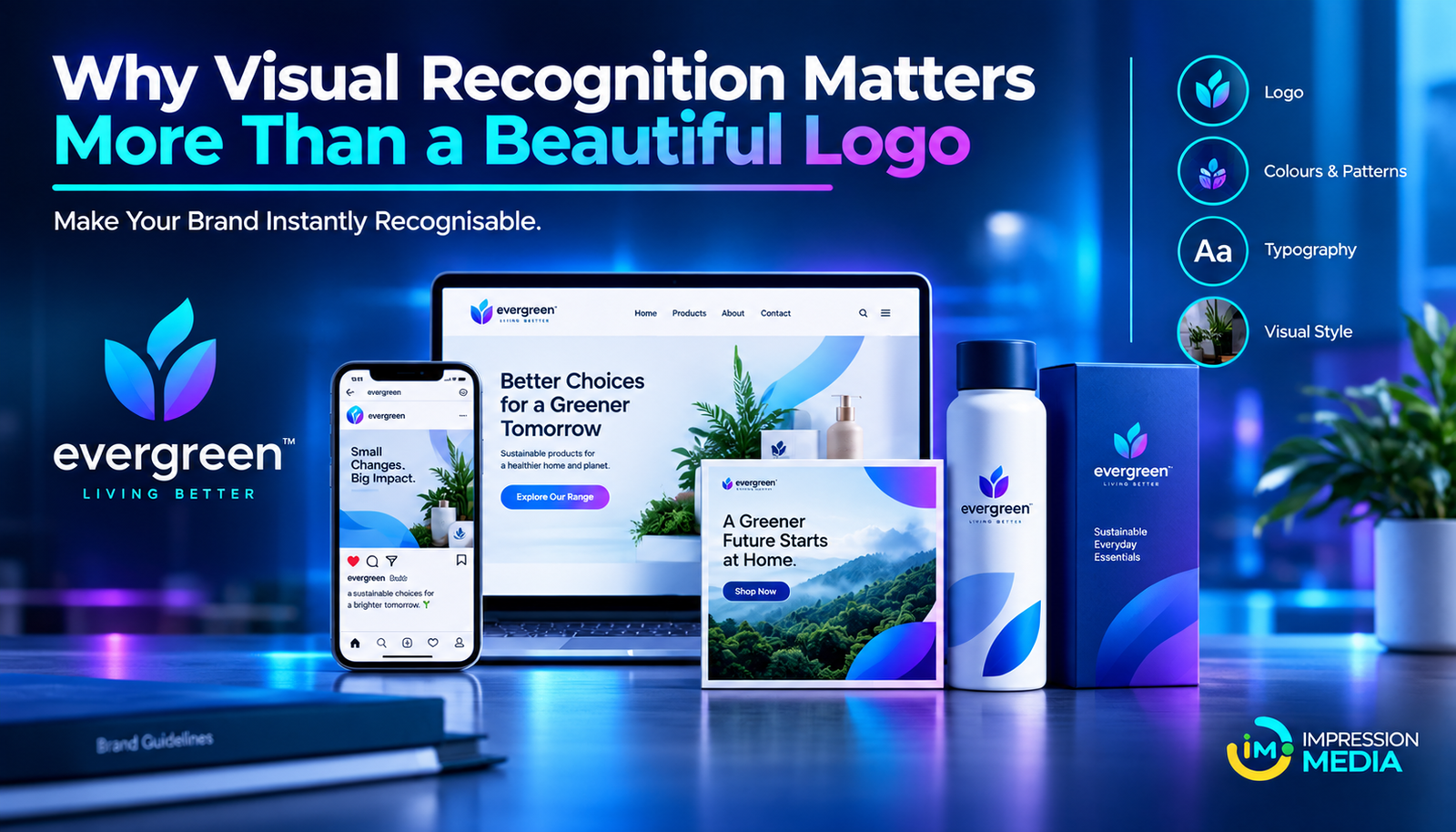
Why Visual Recognition Matters More Than a Beautiful Logo
A beautiful logo can make a strong first impression, but it does not automatically make a brand memorable. Customers see hundreds of brands across websites, social media platforms, advertisements, packaging, and other digital channels. If they cannot recognise your business among those brands, even a professionally designed logo may have limited impact.
This is where visual recognition becomes important. It helps customers identify your brand through consistent colours, typography, imagery, design patterns, and other visual elements. Over time, these elements create familiarity and make your business easier to recognise.
For businesses investing in branding and digital marketing, the goal should not be to create a beautiful logo alone. It should be to build a visual identity that customers can recognise wherever they encounter the brand.
What Is Visual Recognition in Branding?
Visual recognition is the ability of customers to identify a brand through its distinctive visual elements, sometimes without seeing its name or logo.
For example, people may recognise a business through its signature colour combination, a particular packaging style, a consistent advertising layout, or a familiar visual pattern. These elements become associated with the brand through repeated exposure.
A logo is still an important part of this process. However, it works best when supported by a wider visual identity.
A strong visual identity may include:
- Brand colours: A consistent colour palette used across marketing materials.
- Typography: Fonts that reflect the brand's personality and remain readable.
- Imagery: Photographs, illustrations, and graphics with a recognisable style.
- Design patterns: Repeated layouts, shapes, icons, or visual treatments.
- Brand applications: Consistent use of these elements across websites, social media, packaging, and advertisements.
Together, these elements help create a familiar visual experience that extends beyond a single logo.
Why a Beautiful Logo Is Not Enough
A logo gives a brand a visual symbol, but customers do not interact with that symbol in isolation. They encounter the brand through multiple touchpoints, often in different formats and contexts.
A company may have an attractive logo but use different colours in every social media post, inconsistent fonts on its website, and unrelated imagery in its advertisements. These inconsistencies can make the business appear less recognisable.
There are several reasons why relying on a logo alone can limit brand recognition.
Customers Have Limited Attention
Online audiences scroll quickly through social media feeds, websites, and advertisements. Businesses often have only a brief opportunity to attract attention.
A familiar combination of colours, typography, and imagery can help customers identify a brand before they have time to read its name. A logo may be too small, partially hidden, or absent from certain placements, making other visual cues equally valuable.
Customers Remember Patterns Through Repetition
Recognition develops when customers repeatedly encounter consistent visual elements. If a brand changes its design style across different campaigns, it becomes harder for people to connect those experiences.
Consistency does not mean every post or advertisement must look identical. It means that different pieces of content should share enough visual characteristics to feel like they belong to the same brand.
A Logo Cannot Communicate Every Brand Attribute
A logo can suggest a brand's personality, but it cannot communicate every aspect of its identity by itself.
A premium business, for example, may use refined typography, spacious layouts, carefully selected photography, and restrained colours to communicate quality. A technology company might use clean interfaces, structured layouts, and bold graphic elements to suggest innovation.
The complete visual system helps customers understand what the brand represents.
How Visual Recognition Supports Business Growth
A recognisable visual identity can support marketing efforts by making a brand easier to identify across different channels. Its value increases when the business uses the same visual language consistently over time.
1. Builds Familiarity and Trust
Customers are more likely to recognise businesses they have encountered before. Repeated exposure to consistent visual elements can create familiarity, making it easier for people to connect a new advertisement or social media post with a previous interaction.
Familiarity alone does not guarantee trust or a purchase. However, a coherent visual identity can support a more professional and dependable brand impression.
2. Makes Marketing Campaigns More Effective
Marketing campaigns often run across multiple platforms, including search advertising, social media, websites, email, and display advertising.
When each campaign uses recognisable brand elements, customers can connect different messages to the same business. This creates continuity across the customer journey.
For example, someone might discover a brand through a social media advertisement, visit its website a few days later, and then encounter an email campaign. Consistent design can help make those separate interactions feel connected.
3. Helps Businesses Stand Out From Competitors
Many businesses in the same industry use similar messaging, stock photographs, and generic design templates. Without a distinctive visual identity, a brand can easily blend into the competition.
Businesses can improve differentiation by developing a recognisable approach to colours, imagery, composition, typography, and graphic elements.
The objective is not to make every design unusual. It is to establish a visual style that feels relevant to the business and distinct from competing brands.
4. Improves Recognition Across Digital Channels
A brand may appear on a large desktop website, a small mobile screen, a social media profile, or a compact digital advertisement. Its visual identity needs to remain recognisable in all these environments.
A well-planned system helps businesses adapt designs to different formats without losing their core characteristics.
This is particularly important for companies using several digital marketing channels to reach their audiences.
How to Build a Recognisable Visual Identity
Creating visual recognition requires more than selecting attractive colours or hiring a designer to create a logo. Businesses need a clear visual strategy that can be applied consistently.
Define Your Brand Personality
Start by identifying how you want customers to perceive your business. Decide whether your brand should feel approachable, premium, innovative, dependable, energetic, or professional.
These qualities should guide visual decisions, including colours, typography, photography, and layouts.
When the visual identity reflects the brand's actual positioning, it becomes easier to create a coherent experience.
Develop a Consistent Colour Palette
Choose a primary colour palette and define how each colour should be used. Establish supporting colours for backgrounds, highlights, buttons, and other design elements.
Avoid changing the main colour scheme simply because a new trend becomes popular. A brand can introduce seasonal campaigns and creative variations while retaining its recognisable core colours.
Establish Typography and Imagery Guidelines
Select fonts that support your brand personality and remain readable across devices. Define how headings, body text, and promotional messages should appear.
Apply similar care to imagery. Decide whether your brand will use realistic photography, illustrations, bold graphics, minimal compositions, or a particular visual treatment.
These guidelines help maintain consistency even when multiple designers or marketing teams create content.
Create a Flexible Design System
A recognisable brand should be consistent without becoming repetitive.
Create templates and design rules for common marketing assets, such as social media posts, digital advertisements, presentations, email graphics, and website banners.
Each format can have its own layout while sharing recognisable elements. This makes content production more efficient and reduces the risk of inconsistent branding.
Apply the Identity Across Every Touchpoint
Visual recognition grows when customers encounter the same brand characteristics in different places.
Review your website, social media profiles, advertisements, email campaigns, brochures, and other customer-facing materials. Identify where colours, fonts, imagery, and layouts differ unnecessarily.
Correcting these inconsistencies can help create a more unified brand experience.
How to Measure Visual Brand Recognition
Visual recognition is not measured by design quality alone. Businesses need to understand whether people are actually noticing, identifying, and remembering their brand.
Several indicators can help:
- Brand awareness surveys: Ask customers whether they recognise the brand or can identify it from selected visual assets.
- Branded search activity: Monitor searches that include the business name or distinctive brand terms.
- Direct website traffic: Track visits that may indicate people are returning to the brand directly, while recognising that this metric has several possible causes.
- Social media recognition: Observe whether audiences associate recurring visual formats or creative campaigns with your business.
- Customer feedback: Ask customers which visual elements they associate most strongly with the brand.
No single metric provides a complete picture. Combining customer research with digital analytics gives businesses a better understanding of whether their visual identity is becoming more recognisable.
Common Visual Branding Mistakes to Avoid
Even businesses that invest in professional graphic design can weaken their visual recognition through inconsistent execution.
Avoid these common mistakes:
- Changing brand colours too frequently: Constantly changing the main palette prevents customers from building familiarity with it.
- Following every design trend: Trends can provide creative inspiration, but copying them without considering brand identity may make the business look generic.
- Using too many fonts and visual styles:** Excessive variation can make marketing materials feel disconnected.
- Prioritising beauty over usability: Designs should look attractive while remaining readable and adaptable to different screen sizes.
- Treating every campaign as a separate identity: Campaigns can be creative and distinctive without abandoning the brand's established visual language.
The strongest approach balances creativity with consistency.
Conclusion
A beautiful logo can introduce a brand, but visual recognition helps people identify it repeatedly across different interactions. Colours, typography, imagery, layouts, and consistent design choices all contribute to that recognition.
For businesses, the real opportunity is to build a visual identity that remains distinctive across websites, social media, advertising, and other marketing channels. This requires clear brand guidelines, thoughtful design decisions, and consistent execution rather than frequent redesigns.
At Impression Media, businesses can strengthen their brand presence by developing a cohesive visual identity that supports their positioning and digital marketing goals. The aim is not simply to make a brand look attractive. It is to make it easier for the right audience to recognise and remember.
A memorable brand is not defined by its logo alone. It is defined by the complete visual experience customers learn to associate with it.