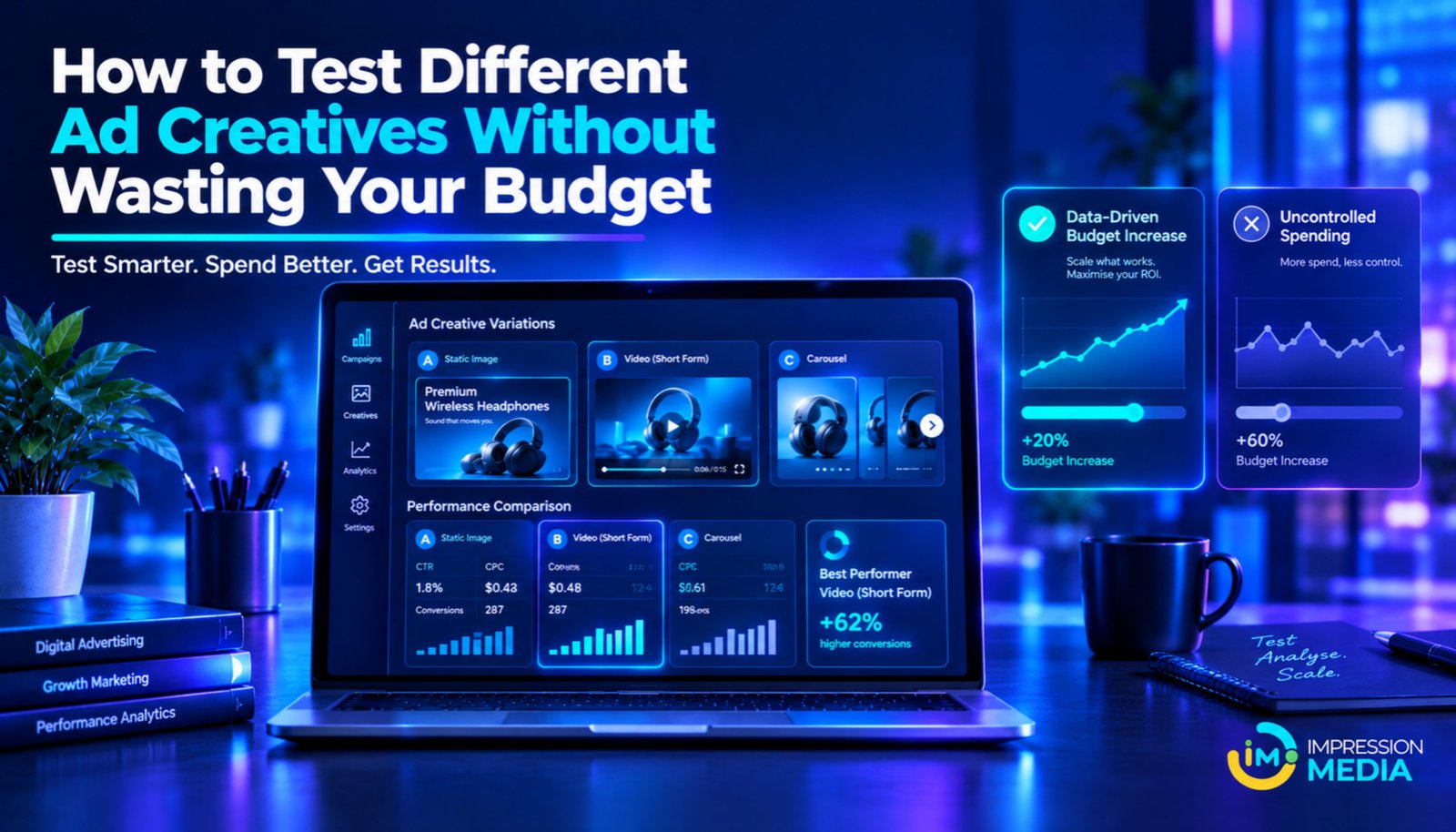
How to Test Different Ad Creatives Without Wasting Your Budget
Running social media advertisements is not just about choosing an audience and setting a daily budget. The creative itself—the image, video, headline, and message—plays an important role in attracting attention and encouraging people to take action.
However, many businesses make the mistake of spending too much money testing several advertisements without a clear plan. They launch multiple creatives, wait for results, and often struggle to understand which version actually works.
For Indian businesses operating with limited marketing budgets, this can become an expensive exercise.
The good news is that creative testing does not require a huge advertising budget. With the right approach, businesses can compare different ad creatives, understand audience preferences, and improve campaign performance without unnecessary spending.
What Is Ad Creative Testing?
Ad creative testing is the process of comparing different versions of advertisements to understand which ones perform better with a target audience.
A creative can include several elements:
- Images and graphics
- Short-form videos and reels
- Headlines and primary text
- Calls to action (CTAs)
- Offers and promotional messages
- Visual styles and formats
For example, an Indian clothing brand might test two advertisements for the same product. One could feature a professional product photograph, while the other uses a short video showing how the clothing looks when worn.
By comparing their performance, the business can identify which creative attracts more relevant customers.
The objective is not simply to find the advertisement with the most likes. It is to identify the creative that supports the campaign goal, whether that means generating enquiries, driving purchases, or increasing qualified website visits.
Why Businesses Should Test Ad Creatives Before Increasing Their Budget
An advertisement that looks attractive to a marketing team may not necessarily appeal to its target audience. Creative testing helps businesses make decisions based on actual audience behaviour rather than personal preferences.
Understand What Your Audience Responds To
Different audiences respond to different messages and visual styles.
For example, a real estate company promoting apartments in Bhubaneswar might find that one audience responds better to property walkthrough videos, while another prefers advertisements highlighting location, amenities, and pricing.
Testing helps businesses discover which creative approach communicates value more effectively.
Reduce Unnecessary Advertising Expenses
Without testing, businesses may continue spending money on advertisements that generate clicks but very few enquiries or sales.
Comparing creative variations helps identify weak advertisements before allocating a larger budget to them.
This makes it easier to direct advertising spend towards creatives that show stronger potential.
Improve Campaign Performance Over Time
Audience preferences change, competitors introduce new campaigns, and advertisements can gradually lose their effectiveness.
Regular creative testing helps businesses identify new opportunities, refresh existing campaigns, and avoid depending on a single advertisement for too long.
How to Test Different Ad Creatives Without Wasting Money
An effective creative testing process starts with a clear objective. Instead of testing everything at once, focus on changes that can provide useful insights.
1. Define One Clear Campaign Objective
Before creating advertisements, decide what you want to achieve.
Your objective could be:
- Generating leads for a service.
- Increasing online product sales.
- Driving traffic to a website.
- Encouraging people to register for an event.
- Promoting a new product or offer.
Your objective determines which metrics matter.
For a lead generation campaign, cost per qualified lead may be more useful than likes or video views. For an e-commerce campaign, purchases and return on ad spend (ROAS) may be more relevant.
2. Test One Major Creative Element at a Time
Changing the image, headline, offer, and audience simultaneously makes it difficult to understand what influenced the results.
Start by testing one major variable.
For example, if you are advertising a skincare product, you could compare:
- Creative A: A product-focused image.
- Creative B: A short video demonstrating product application.
Keep the audience, offer, placement, and other campaign settings as consistent as possible.
This makes the comparison more meaningful.
Once you understand which visual format performs better, you can test different headlines or messages.
3. Start With a Small, Controlled Budget
You do not need to spend thousands of rupees on every creative variation.
For example, a small business could begin with a testing budget of ₹500–₹1,000 per day, depending on its objectives, audience size, and expected conversion costs.
This is an illustrative starting point, not a universal budget recommendation.
Divide the available budget sensibly and avoid launching more variations than you can evaluate properly.
If the budget is limited, testing two or three meaningful creative variations is generally more useful than spreading money across ten similar advertisements.
4. Use Different Creative Formats
Testing different formats can reveal how your audience prefers to consume advertising content.
Consider comparing:
- Static images: Useful for product promotions, offers, and simple messages.
- Short-form videos: Helpful for demonstrations, product features, customer experiences, and storytelling.
- Carousel advertisements: Useful when businesses need to showcase multiple products, features, or steps.
- Customer testimonials: Can communicate real experiences and provide social proof, provided the testimonials are genuine and used with permission.
Choose formats that suit your product, audience, and advertising objective.
5. Give Your Advertisements Enough Time to Collect Data
Do not stop an advertisement immediately because it receives fewer clicks during its first few hours.
Campaign performance can fluctuate, especially when budgets are small or conversion volumes are low.
Allow sufficient time and spending for meaningful evaluation. The appropriate testing period depends on your sales cycle, campaign volume, and conversion objective.
Avoid making frequent changes that interrupt the comparison or make the results difficult to interpret.
Which Metrics Should You Track During Creative Testing?
The right metrics help businesses understand whether an advertisement is attracting attention and generating meaningful business outcomes.
| Metric | What it tells you |
|---|---|
| Click-through rate (CTR) | How often people click after seeing an ad |
| Cost per click (CPC) | How much each click costs |
| Conversion rate | How many visitors complete the desired action |
| Cost per lead (CPL) | How much each lead costs |
| Cost per acquisition (CPA) | How much it costs to acquire a customer |
| Return on ad spend (ROAS) | Revenue generated relative to advertising spend |
Do not judge a creative using one metric alone.
For example, an advertisement may have a high CTR but generate poor-quality enquiries. Another may receive fewer clicks but attract customers who are more likely to purchase.
The better creative is the one that supports your actual business objective.
Common Ad Creative Testing Mistakes to Avoid
Even businesses that regularly run social media advertisements can make testing mistakes that lead to unnecessary spending.
Testing Too Many Advertisements Together
Launching too many variations with a small budget can leave each creative with insufficient data.
Start with a manageable number of variations and expand testing when you have enough evidence to make decisions.
Choosing Winners Based Only on Likes and Comments
Engagement can indicate audience interest, but it does not always translate into sales or enquiries.
Look beyond reactions and evaluate conversions, lead quality, and customer acquisition costs.
Ignoring the Landing Page Experience
An advertisement may attract the right audience, but a slow or confusing landing page can prevent visitors from converting.
Make sure the message in your advertisement matches the landing page. Check page speed, mobile usability, form design, and calls to action before blaming the creative for poor results.
Reusing the Same Creative for Too Long
Repeatedly showing the same advertisement can reduce audience interest over time.
Monitor performance trends and refresh creatives when engagement or conversion efficiency begins to decline. Do not replace advertisements simply because they have been running for a particular number of days.
How Indian Businesses Can Build a Smarter Creative Testing Process
Businesses in India often target audiences across different cities, languages, age groups, and purchasing behaviours. A creative that works in one market may not perform equally well in another.
For example, a restaurant promoting food delivery in Bengaluru may need a different message from one targeting customers in Bhubaneswar. Similarly, a local service provider may benefit from regional language creatives, while a B2B company targeting decision-makers may need more informative advertisements.
Consider these practical steps:
- Understand your audience: Identify their needs, location, preferences, and buying behaviour.
- Create relevant variations: Test different visuals, messages, and formats that address those needs.
- Keep the offer consistent: Avoid changing multiple campaign elements during a single comparison.
- Measure meaningful outcomes: Evaluate qualified leads, purchases, and acquisition costs.
- Use the findings: Apply successful creative approaches to future campaigns and continue testing new ideas.
Businesses should also review advertising platform policies and ensure that their creatives follow applicable requirements.
Conclusion
Testing different ad creatives is an important part of successful social media advertising. It helps businesses understand what attracts their audience, which messages encourage action, and where advertising budgets can be used more effectively.
The process does not need to be complicated or expensive. Start with a clear objective, test a small number of meaningful variations, track the right metrics, and make decisions based on reliable results.
For Indian businesses looking to improve their advertising performance, creative testing can help reduce guesswork and make campaigns more efficient.
At Impression Media, a structured social media advertising approach can help businesses combine creative strategy, audience targeting, and performance analysis to make better marketing decisions.
The goal is not to create more advertisements. It is to discover which advertisements deliver more meaningful results for your business.